
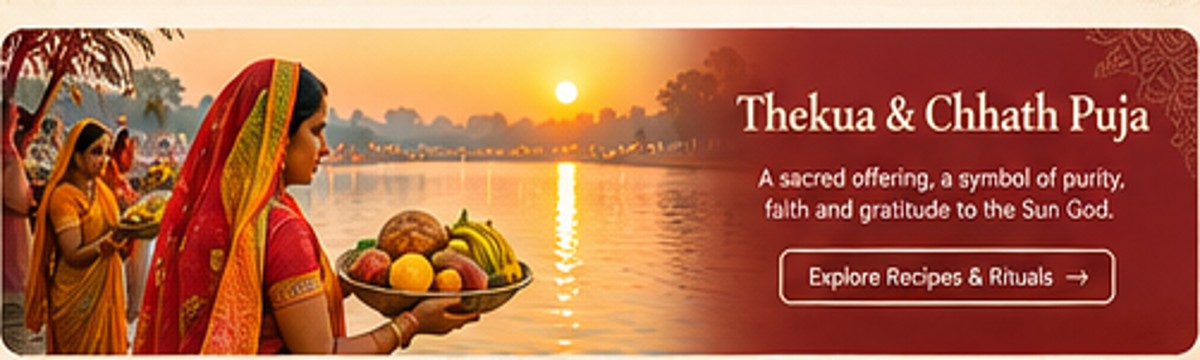
In many Bihari homes, the fragrance of freshly prepared Thekua brings to mind Chhath Puja: the baskets of offerings, the gathering by the water, the quiet discipline of the vrat and the prayers offered to the setting and rising sun.
What is Chhath Puja?
Chhath Puja is a festival dedicated to the worship of Surya, the Sun God, and Chhathi Maiya. It is observed with deep devotion in Bihar, Jharkhand, eastern Uttar Pradesh and by communities living elsewhere. The festival is known for its rituals of fasting, cleanliness, offerings and prayers at a river, pond or other water body.
Devotees traditionally offer arghya to the setting sun and, on the following morning, to the rising sun. Families and communities often come together at the ghats, carrying soops and baskets filled with seasonal fruits and offerings. Practices vary across families and regions, and the observance is shaped by local customs.
Why is Thekua associated with Chhath?
Thekua is commonly prepared as prasad in many Bihari households during Chhath. It is valued not only as a sweet but also as a food prepared with care for an important family and community observance. For many people, its presence in the offering basket is part of the festival memory: the preparation at home, the sharing among relatives and the respect given to the prasad.
Thekua recipes are not identical everywhere. Some families use jaggery, while others use sugar. The dough may include wheat flour, ghee, coconut, fennel or cardamom, depending on household practice. The shape and mould patterns can also differ.
The meaning of the soop and offerings
The soop, traditionally a winnowing basket, is used in many households to arrange offerings. Seasonal fruits, sugarcane and other items may be included according to family and regional custom. Thekua is often placed among these offerings. The arrangement is more than decoration: it is an expression of devotion, preparation and gratitude.
At the ghat, the collective sight of families, baskets, lamps and reflections on the water creates a powerful atmosphere. The festival reminds devotees of the life-giving energy of the sun and the importance of nature in everyday life.
A preparation shaped by family tradition
In many homes, Thekua preparation is a shared activity. One person may prepare the dough, another may shape each portion, and someone else may use a wooden mould to press a decorative design into the surface. The pieces are then fried until cooked and golden-brown. The exact method, ingredients and timing differ from one family to another.
These family methods are part of what makes food traditions meaningful. A recipe may be remembered through the hands that taught it, the mould used year after year, or the familiar taste associated with a particular celebration.
Tradition carried forward
For Thekua Parampara, this connection between food and memory is at the heart of the name. “Parampara” speaks of a tradition carried forward. Thekua is one way many families celebrate that continuity — through preparation, offering and sharing.
As with all religious and cultural practices, Chhath observances are personal and can differ. We share this article as a respectful introduction to traditions followed by many families, not as a rulebook for every household.